
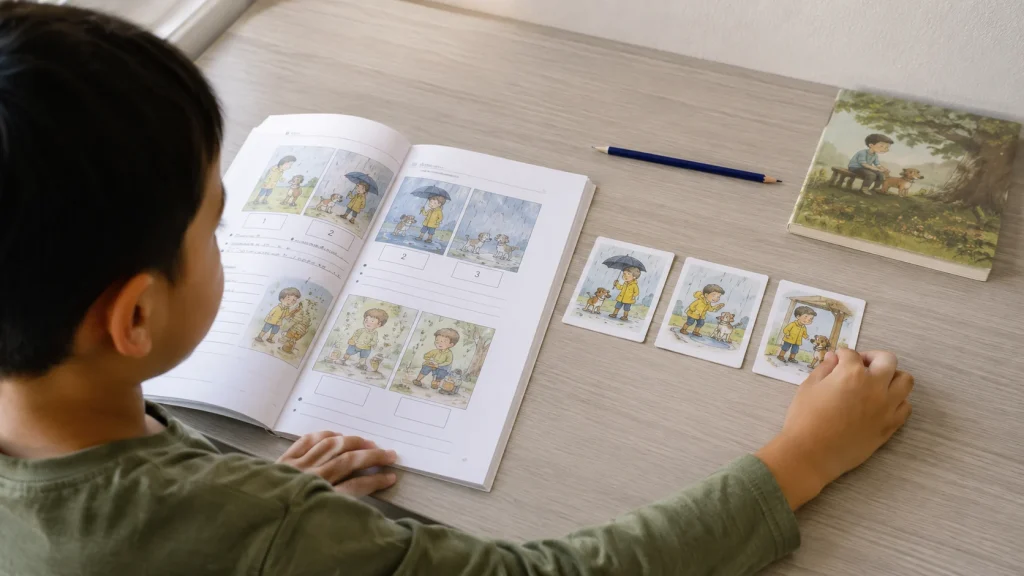
Cerita pendek membantu anak belajar bahasa Inggris melalui tokoh, tindakan, masalah, dan kejadian yang mudah diingat. Namun, bacaan untuk anak SD perlu disesuaikan dengan kemampuan mereka. Anak kelas III biasanya membutuhkan kalimat yang lebih pendek dan pertanyaan faktual, sedangkan anak kelas V dan VI mulai dapat berlatih memahami sebab-akibat, perasaan tokoh, gagasan utama, serta informasi tersirat.
Kumpulan berikut dibagi menjadi tiga tingkat kesulitan. Cerita pada level pemula menggunakan kosakata sehari-hari dan alur sederhana. Pada level berikutnya, cerita menjadi sedikit lebih panjang dengan pertanyaan yang membutuhkan pemahaman lebih mendalam.
Semua cerita di bawah ini ditulis secara orisinal sehingga dapat digunakan untuk latihan di rumah, les privat, atau kegiatan membaca di kelas.
Cara Menggunakan Cerita Ini
Mintalah anak membaca cerita bahasa Inggris terlebih dahulu tanpa langsung menerjemahkan setiap kalimat. Anak cukup mencoba memahami siapa tokohnya, apa yang terjadi, dan bagaimana ceritanya berakhir.
Setelah itu, anak dapat menjawab pertanyaan pemahaman. Untuk kelas rendah, orang tua atau guru juga dapat membacakan cerita dengan suara lantang sambil menjelaskan beberapa kosakata sulit.
Cerita Level Pemula
1. The Lost Pencil
Rina had a new yellow pencil. She used it to write in her English book. After lunch, the pencil was not on her desk.
Rina looked under her chair and inside her bag. Then Budi came to her.
“Is this your pencil?” he asked.
Budi found the pencil near the classroom door. Rina smiled and thanked him.
Kosakata:
- pencil: pensil
- under: di bawah
- found: menemukan
- thanked: berterima kasih
Pertanyaan:
- What colour was Rina’s pencil?
- Where did Budi find the pencil?
- How did Rina feel at the end?
Kunci jawaban:
- It was yellow.
- He found it near the classroom door.
- She felt happy or relieved.
2. Milo and the Rain
Milo wanted to play football outside. He put on his shoes and opened the front door.
Suddenly, heavy rain began to fall. Milo could not play in the garden.
His father brought two chairs and a soft ball into the living room. They made a small goal and played football inside.
Milo was happy again.
Kosakata:
- heavy rain: hujan deras
- garden: halaman atau kebun
- living room: ruang keluarga
- goal: gawang
Pertanyaan:
- What did Milo want to play?
- Why could he not play outside?
- True or false: Milo played alone in his bedroom.
Kunci jawaban:
- He wanted to play football.
- Because it was raining heavily.
- False. He played with his father in the living room.
3. A New Friend
Lina was new at school. She sat quietly at the back of the classroom.
During break time, the other children played together. Lina stayed near the window because she did not know anyone.
Sari walked over to her and said, “Would you like to play with us?”
Lina nodded and followed Sari outside. Soon, they were laughing together.
Kosakata:
- quietly: dengan tenang
- break time: waktu istirahat
- nodded: mengangguk
- followed: mengikuti
Pertanyaan:
- Why did Lina stay near the window?
- Who invited Lina to play?
- How did Lina’s feelings probably change?
Kunci jawaban:
- Because she did not know anyone.
- Sari invited her.
- She probably changed from feeling nervous or lonely to feeling happy.
4. The Red Lunch Box
Arman opened his school bag, but his red lunch box was not there. He remembered putting it on the kitchen table.
At lunchtime, Arman told his teacher that he had no food. His friend Dito shared a sandwich and a banana with him.
When Arman arrived home, he saw the lunch box on the table. His mother smiled and said, “Let’s put it in your bag tonight.”
Kosakata:
- remembered: teringat
- shared: berbagi
- arrived: tiba
- tonight: malam ini
Pertanyaan:
- Where was Arman’s lunch box?
- What food did Dito share?
- What will Arman probably do that night?
Kunci jawaban:
- It was on the kitchen table.
- He shared a sandwich and a banana.
- He will probably put the lunch box in his school bag.
5. Grandma’s Garden
Nina visited her grandmother on Sunday. Her grandmother had a small garden behind the house.
Together, they watered the tomatoes, pulled out weeds, and picked three red chillies.
Nina saw a small green caterpillar on a leaf. She wanted to touch it, but Grandma asked her to watch it carefully without hurting it.
Nina enjoyed working in the garden.
Kosakata:
- watered: menyiram
- weeds: rumput liar
- picked: memetik
- caterpillar: ulat
Pertanyaan:
- What vegetables did Nina and Grandma pick?
- What animal did Nina see?
- Why did Grandma ask Nina to be careful?
Kunci jawaban:
- They picked three red chillies.
- She saw a green caterpillar.
- So Nina would not hurt it.
Cerita Level Menengah
6. The Library Card
Fajar loved reading adventure stories. One afternoon, he went to the school library to borrow a new book.
When he reached the librarian’s desk, he could not find his library card. He checked every pocket, but the card was missing.
Fajar walked back to his classroom. His card was under his English notebook. He quickly returned to the library before it closed.
This time, he put the card in a small pocket inside his bag.
Kosakata:
- borrow: meminjam
- librarian: petugas perpustakaan
- missing: hilang
- closed: tutup
Pertanyaan:
- Why did Fajar go to the library?
- Where did he find his library card?
- What did Fajar do to prevent the same problem?
Kunci jawaban:
- He wanted to borrow an adventure book.
- He found it under his English notebook.
- He put it in a small pocket inside his bag.
7. The Broken Kite
Ayu and her brother made a kite from paper and thin pieces of wood. They took it to a field near their house.
At first, the kite flew high above them. Then a strong wind pushed it towards a tree. The kite hit a branch, and one side tore.
Ayu felt disappointed, but her brother did not want to give up. They took the kite home, repaired it with tape, and tried again the next morning.
Kosakata:
- field: lapangan
- branch: dahan
- tore: robek
- repaired: memperbaiki
Pertanyaan:
- What caused the kite to hit the tree?
- How did Ayu feel when the kite tore?
- What did the children do after the accident?
Kunci jawaban:
- A strong wind pushed it towards the tree.
- She felt disappointed.
- They took it home and repaired it with tape.
8. A Surprise for Mum
Mum’s birthday was on Saturday. Rafi and his sister, Maya, wanted to prepare a surprise before she woke up.
Maya made a birthday card while Rafi helped Dad cook pancakes. They placed the pancakes, some fruit, and the card on a tray.
When Mum entered the dining room, everyone shouted, “Happy birthday!”
Mum looked at the breakfast and smiled. The pancakes were not perfectly round, but she said they were the best pancakes she had ever eaten.
Kosakata:
- prepare: menyiapkan
- tray: nampan
- shouted: berseru
- perfectly round: bulat sempurna
Pertanyaan:
- What did Maya make?
- Who helped Rafi cook the pancakes?
- Why did Mum call them the best pancakes?
Kunci jawaban:
- She made a birthday card.
- Dad helped him.
- Contoh jawaban: Because her family made them with love for her birthday.
9. The Little Bird
On the way home, Sinta saw a small bird sitting on the ground. It tried to fly, but one of its wings looked weak.
Sinta did not pick it up immediately. She called her mother, who brought a cardboard box and a soft towel.
They placed the box in a quiet area and contacted a local animal rescuer. The rescuer arrived later and took the bird somewhere safe.
Sinta was worried, but she was glad that she had asked an adult for help.
Kosakata:
- wing: sayap
- weak: lemah
- towel: handuk
- rescuer: petugas penyelamat
Pertanyaan:
- What problem did the bird have?
- Why did Sinta call her mother?
- Was Sinta’s decision sensible? Explain your answer.
Kunci jawaban:
- One of its wings looked weak.
- She needed an adult to help the bird safely.
- Contoh jawaban: Yes. She did not handle the injured bird alone and asked an adult for help.
10. The Class Pet
Class 4B had a small brown hamster named Coco. Every day, one student was responsible for checking its food and water.
On Tuesday, it was Bayu’s turn. He filled Coco’s water bottle but forgot to close the cage door properly.
A few minutes later, the cage was empty. The whole class searched quietly. Finally, their teacher found Coco hiding behind a box of books.
Bayu apologised and checked the door twice before putting Coco back.
Kosakata:
- responsible: bertanggung jawab
- properly: dengan benar
- empty: kosong
- apologised: meminta maaf
Pertanyaan:
- What mistake did Bayu make?
- Where was Coco found?
- What did Bayu learn from the experience?
Kunci jawaban:
- He did not close the cage door properly.
- Coco was found behind a box of books.
- He learned to check the cage door carefully.
Cerita Level Lebih Menantang
11. The Last Bus Stop
Nadia usually got off the school bus beside a small bakery. One afternoon, she was reading a comic and did not notice the bakery outside.
When she looked up, the bus was already moving towards the final stop. Nadia felt frightened, but she remembered what her parents had taught her.
She stayed in her seat and told the driver what had happened. The driver called the school office and then took Nadia back to the bakery.
Her father was waiting there. He was worried, but proud that Nadia had asked a trusted adult for help.
Kosakata:
- got off: turun dari kendaraan
- noticed: menyadari atau melihat
- frightened: ketakutan
- trusted adult: orang dewasa yang dapat dipercaya
Pertanyaan:
- Why did Nadia miss her usual stop?
- What did she do after she realised her mistake?
- Why was her father proud of her?
Kunci jawaban:
- She was reading a comic and did not notice the bakery.
- She stayed on the bus and told the driver.
- Because she stayed calm and asked a trusted adult for help.
12. The Empty Water Bottle
The students of Class 5 were preparing for a sports competition. Their teacher reminded everyone to bring enough drinking water.
Dimas filled his bottle in the morning, but he drank most of it before the competition began. During running practice, he became tired and found that his bottle was empty.
His friend Riko shared some water while the teacher asked Dimas to rest. The next day, Dimas brought a larger bottle and drank small amounts throughout the practice.
Kosakata:
- competition: perlombaan
- reminded: mengingatkan
- throughout: sepanjang
- amounts: jumlah
Pertanyaan:
- Why was Dimas’s bottle empty?
- Who helped him?
- What did Dimas change the next day?
- What is the main lesson of the story?
Kunci jawaban:
- He drank most of the water before the competition began.
- Riko and the teacher helped him.
- He brought a larger bottle and drank small amounts throughout the practice.
- Contoh jawaban: We should bring enough water and drink it wisely during physical activity.
13. The Team That Would Not Give Up
During the school football match, Beni’s team conceded two goals in the first half. Some players began blaming one another.
Their captain, Wawan, asked everyone to stop arguing. He reminded them that the match was not over. The players agreed to communicate better and pass the ball more often.
In the second half, they scored twice. The match ended in a draw.
They did not win the match, but their teacher praised them for working together and changing their attitude.
Kosakata:
- blaming: menyalahkan
- arguing: bertengkar
- communicate: berkomunikasi
- draw: hasil seri
Pertanyaan:
- What was the score after the first half?
- What problem did the team have besides losing?
- What changes did they make in the second half?
- Why did the teacher praise them?
Kunci jawaban:
- They were losing by two goals.
- The players were blaming and arguing with one another.
- They communicated better and passed the ball more often.
- Because they worked together and improved their attitude.
14. The Noise in the Kitchen
Late one evening, Putri heard a strange noise coming from the kitchen. Her parents were still talking in the living room.
Putri first thought that someone had entered the house. Instead of going into the dark kitchen alone, she called her father.
They switched on the light and looked around carefully. A metal spoon was moving across the floor.
Then a small grey cat appeared from behind the rubbish bin. It had entered through an open window while looking for food.
Putri’s father closed the window and placed the cat outside safely.
Kosakata:
- strange: aneh
- instead of: daripada
- appeared: muncul
- rubbish bin: tempat sampah
Pertanyaan:
- What did Putri first think caused the noise?
- Why did she call her father?
- What was really making the noise?
- What might have happened if the kitchen window had been closed?
Kunci jawaban:
- She thought someone had entered the house.
- She did not want to enter the dark kitchen alone.
- A small cat was moving a metal spoon.
- Contoh jawaban: The cat probably could not have entered the kitchen.
15. The Seed in the Old Cup
For a science project, every student received a bean seed. They had to plant it at home and record its growth for two weeks.
Most students used new flowerpots. Tari, however, used an old plastic cup. She made small holes in the bottom, added soil, and placed the seed near a sunny window.
For several days, nothing appeared. Tari continued watering the soil carefully. On the sixth morning, a small green shoot finally came out.
Tari’s plant did not grow faster than the others, but it grew well. She learned that careful work mattered more than having the newest equipment.
Kosakata:
- seed: biji
- record: mencatat
- soil: tanah
- shoot: tunas
Pertanyaan:
- Why did the students plant bean seeds?
- What container did Tari use?
- When did the green shoot appear?
- What is the main message of the story?
Kunci jawaban:
- They were doing a science project.
- She used an old plastic cup.
- It appeared on the sixth morning.
- Contoh jawaban: Good results can come from patience and careful work, even without new equipment.
Memilih Cerita Sesuai Kemampuan Anak
Cerita nomor 1 sampai 5 cocok untuk anak yang baru mulai memahami teks pendek. Sebagian besar jawabannya dapat ditemukan langsung di dalam cerita.
Cerita nomor 6 sampai 10 mulai melatih pemahaman tentang sebab-akibat, masalah dan solusi, serta perubahan perasaan tokoh. Anak mungkin perlu menggabungkan informasi dari beberapa kalimat sebelum menjawab.
Cerita nomor 11 sampai 15 lebih sesuai untuk anak yang sudah cukup nyaman membaca teks sederhana. Beberapa pertanyaannya meminta anak menjelaskan alasan, menarik kesimpulan, atau menemukan pesan utama cerita.
Pembagian level tersebut tidak harus selalu mengikuti kelas sekolah. Anak kelas VI yang baru belajar bahasa Inggris mungkin tetap lebih nyaman memulai dari level pemula. Sebaliknya, anak kelas IV yang sering menggunakan bahasa Inggris bisa mencoba cerita yang lebih menantang.
Agar Latihan Membaca Lebih Efektif
Jangan langsung memberi tahu arti semua kata yang belum dikenal anak. Mintalah anak memperhatikan kalimat sebelum dan sesudahnya untuk menebak arti kata dari konteks.
Setelah menjawab soal, anak dapat diminta menceritakan kembali isi cerita menggunakan dua atau tiga kalimat sederhana. Kegiatan ini membantu menghubungkan kemampuan membaca dengan kemampuan berbicara.
Pertanyaan terbuka juga tidak harus memiliki jawaban yang sama persis dengan kunci. Selama jawaban anak masuk akal dan didukung oleh informasi dalam cerita, jawaban tersebut dapat diterima.
Jika anak dapat memahami cerita tetapi masih kesulitan mengucapkan jawabannya, latihan bersama tutor bisa membantu. Dalam pembelajaran personal, tutor dapat menyesuaikan tingkat bacaan, memperbaiki pengucapan, dan memberikan pertanyaan lanjutan sesuai kemampuan anak.
Kesimpulan
Cerita pendek bahasa Inggris untuk anak SD akan lebih bermanfaat jika tingkat kesulitan, kosakata, dan bentuk pertanyaannya sesuai dengan kemampuan pembaca. Anak dapat memulai dari pertanyaan sederhana tentang tokoh dan tempat, lalu perlahan berlatih memahami sebab, perasaan, solusi, serta pesan utama cerita.
Tujuannya bukan memahami setiap kata, melainkan mengikuti jalannya cerita, menemukan informasi penting, dan menjelaskan kembali isi bacaan.
Referensi
- Rumah Pendidikan: Pengertian Capaian Pembelajaran
- Cambridge English: Pre A1 Starters Exam Format
- British Council LearnEnglish Kids: Getting Started
- Education Endowment Foundation: Reading Comprehension Strategies
- Reading Rockets: Story Maps
- Reading Rockets: Question-Answer Relationship
- FairytaleQA: Question Answering Dataset for Narrative Comprehension